Product
Introducing DBGorilla: Postgres Monitoring With Proof Before Production
Most database monitoring stops right when the useful work begins. DBGorilla keeps going after the alert. It works through what changed, forms a hypothesis, and tests it on an instant clone before handing the result to your team.
 Cornelius·
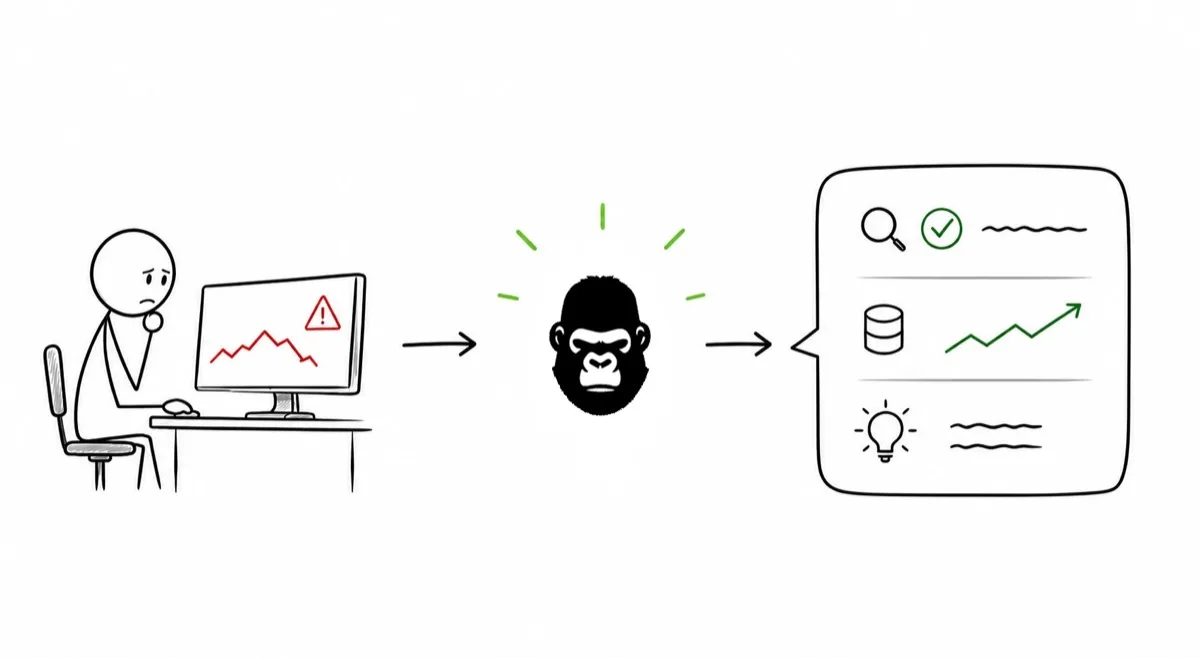
We built it because most database monitoring stops right when the useful work begins. It tells you latency is up, CPU is spiking, or a query suddenly got slower. Then it gives you a wall of graphs and leaves someone to figure out what actually happened. We have graphs too, quite a lot of them, but a graph is not a root cause.
That investigation usually lands with the same small group of DBAs and Engineers. They get pulled into the slow query, the migration that behaved differently in production, the index nobody is sure about, and the steady stream of questions from engineers trying to understand why the database is doing what it is doing. The problem is rarely a lack of alerts. It is that every alert creates another investigation someone has to start from scratch.
DBGorilla keeps going after the alert. It looks at what changed, works through the likely cause, develops a hypothesis, and tests that hypothesis on an instant clone before handing the solution to the team. The engineers still decide what happens next. We just want that decision to start with evidence instead of another hour spent clicking through dashboards.
It also answers the everyday database questions that do not begin with an incident: how to optimize a query, whether an index makes sense, what a migration might break, or why something that worked last month is slow now.
The point is not to replace the database expert. It is to stop making the database expert personally investigate every question before the rest of the team can move.
DBGorilla monitors Postgres and tests every recommendation
DBGorilla watches your Postgres databases continuously and tracks every change that could impact performance. If something degrades, it starts working through what happened, what is affected, and what might fix it instead of handing you an alert and calling the job done.
Underneath is a continuous agentic loop: observe, diagnose, validate, create the resolution, alert the team, and learn. That is a lot of verbs, admittedly, and the point is simple. DBGorilla keeps going, keeping your database in an optimal state.
Every recommendation is tested on an instant clone before it reaches your team. If DBGorilla thinks a query change, index, or configuration adjustment will help, it tries the change first and shows you the result. You decide what ships.
Get answers without starting another database investigation
Database work does not begin and end with an alert. Engineers have questions all day: why is this query slow, does this index make sense, what will this migration break, is the configuration wrong, and why did something that worked last month suddenly stop working?
Those questions often end up with a DBA or the one engineer that knows the database. Sometimes they should. A lot of the time, though, the first hour is spent gathering context, checking the same things, and figuring out what question everyone is actually trying to answer.
DBGorilla does that work against the connected database. You can ask about queries, indexes, schema, migrations, configuration, and the rest of the things that eventually become “can someone from the database team look at this?” The answer comes with the database context behind it rather than a generic explanation of what Postgres usually does.
Leveraging our CLI or the MCP server, questions can easily be asked and insights can be pulled straight from your IDE or directly from your coding agent. This gives your favorite coding agent a path to understanding exactly how the database performs today instead of AI having to guess based on the code base it has access to.
The point is not to give your team another dashboard to remember. It is to answer the question where the question already came up.
What DBGorilla deliberately does not do
DBGorilla also does not train on or use your data to train models. The database context is used to answer your questions, investigate issues, and validate recommendations for your environment. It does not become training data for someone else’s system. Your data stays yours.
Give DBGorilla a try
DBGorilla is live in preview with three tiers: Free, Pro, and Business. While we are in preview, everyone gets Pro free for the first 30 days.
Install a simple collector that can access your Postgres database and give it the work your team is already dealing with: slow queries, questionable indexes, migrations, configuration tuning, maintenance problems, and the things nobody wants to touch late on a Friday.
Then tell us what worked, what did not, and where you managed to break it.