Article
What happens when everyone can, and does, write code?
If you’ve read any of my posts (thank you) you probably know I’m an AI fanboy. I started an AI-based company, so no surprise there. I’ve been reading a lot of posts about individuals using AI to write code, and I love it, it’s empowering and exciting. But a team of engineers using AI on a shared codebase is a very different challenge and it feels like no one is talking about it. So here we go.
 Chris Lalonde | Co-Founder and CEO, DBGorilla·
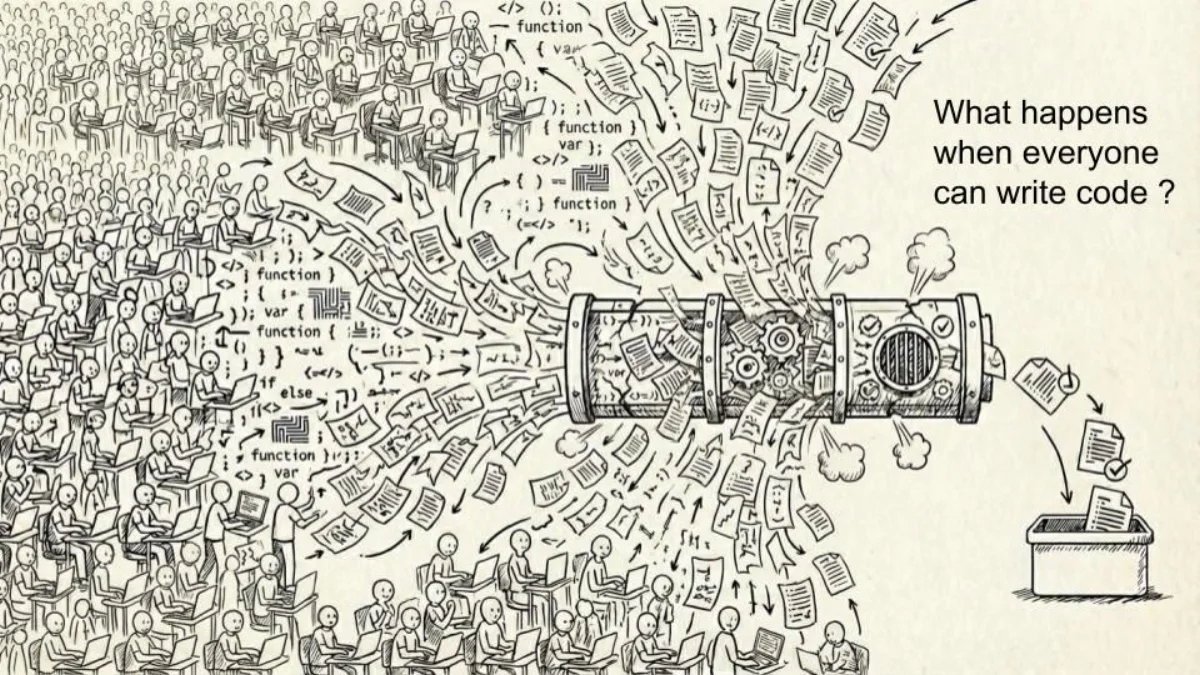
AI has changed the pace of development. Teams can move from idea to implementation much faster than they could even six months ago.
But shipping software has never been just about writing code.
Every change still has to move through review, testing, integration, deployment, and production support. If those systems are weak, faster code generation does not create more progress. It creates more pressure everywhere else, and that pressure leads to failures.
That is the shift a lot of teams are starting to feel, or will soon.
For years, companies could get by with delivery systems that were a little messy and communication that was not always great. The pace was slower, the volume was lower, and a lot of friction was tolerated. To a point, that even worked. Teams could rely on shared context and informal coordination. That gets a lot harder when the volume of change starts to spike.
And AI is absolutely creating that kind of spike.
AI can x10 or x100 increases the rate of change. Which means weaknesses in the system show up that much faster, and small errors compound much more quickly.
The bottleneck is no longer development capacity. It is a team’s ability to absorb and manage change.
So what do you do ?
CI/CD absolutely helps, and small teams no longer have any excuse for having a poor pipeline. But CI/CD is not the whole answer. If communication across teams is weak, shared context is poor, or coordination isn’t there, faster pipelines just help problems move to your customers faster.
The teams that get the most out of AI will not be the ones producing the most code. They will be the ones that can absorb the most change, catch issues early, and stay aligned as the pace increases.
In a world where everyone writes code, writing code is not the hard part.
Shipping good code still is.